Albert Park, Melbourne. March 16, 2014. The race starts at five in the
afternoon, and the field streams toward the first corner.
That evening, the chairman of the race is complaining to Bernie
Ecclestone.
The cars sound different because everything inside them is different. This is the story of the winter Formula 1 rewrote its engines, and what the rewrite did to the sport.
Chapter I
THE RULEBOOK
The 2014 regulations retire the naturally-aspirated V8 permanently and
replace it with a 1.6-litre turbocharged V6 — the first forced-induction
engines in Formula 1 since 1988.
The word “engine” stops being adequate. The rules now describe a
The hybrid hardware is not a gimmick bolted to the side. The old KERS system
gave a driver roughly 80 horsepower for about six seconds a lap. The 2014
Fuel becomes a regulated resource. A
Even development changes shape. The V8-era engine “freeze”, which prohibited
manufacturers from upgrading their engines, gives way to a
Chapter II
THE WINTER
The formula nearly looked different again. The original proposal was for
four-cylinder turbocharged engines. The teams pushed back, Ferrari loudest
among them, and the compromise that emerged permitted a V6
instead.
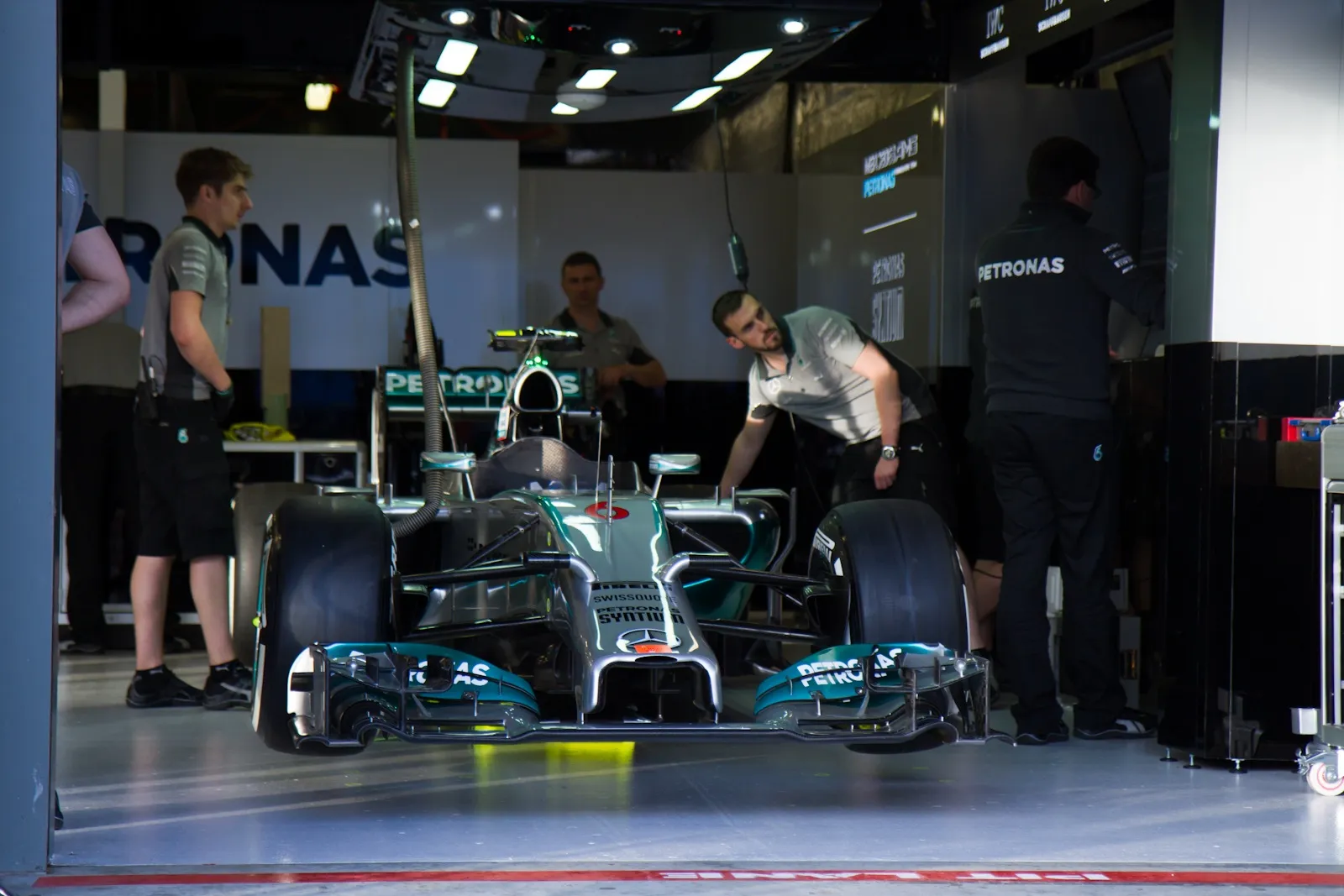
At Melbourne, the paddock gets its first proper look at what Mercedes has
done with the new rulebook. Racecar Engineering’s Peter Wright reports that
Mercedes has split the turbocharger: the compressor sits at the front of the
engine, the turbine at the rear, and between them, mounted in the V, sits the
MGU-H, driving and driven through connecting
shafts.
Chapter III
MELBOURNE
Qualifying runs in the rain. Lewis Hamilton takes pole with a 1:44.231;
Daniel Ricciardo puts his Red Bull second at his home race, with Nico Rosberg
third.
The race exposes the new machinery within seconds. Hamilton’s engine loses a
cylinder at the start. He drops to third by the first corner, keeps sinking,
and is called in to retire on lap
2.
At the front, none of it matters to Rosberg. He passes Ricciardo and his own
teammate off the line, leads at the first corner, and is never
headed.
Ricciardo crosses the line second in front of his home crowd. Hours later,
the stewards disqualify him: his car breached Article 5.1.4, the fuel-flow
limit.
What the 2014 rulebook said about fuel
Article 5.1.4 of the 2014 Technical Regulations: “Fuel mass flow must not
exceed 100kg/h.”
The disqualification promotes Kevin Magnussen, on debut, to second place,
the first podium finish by a Danish driver, and Jenson Button to third — the
50th and last podium of his career. The ceremony had already taken place, so
Button never stood on it.
Chapter IV
THE SOUND
The complaint arrives before the cars are packed. Ron Walker, chairman of the
Australian Grand Prix Corporation, raises the noise with Ecclestone the night
of the race, and the organisers go further: the quieter cars, they say, may
have breached their contract. “We pay for a product, we’ve got contracts in
place, we are looking at those very, very seriously,” chief executive Andrew
Westacott says.
Ecclestone needs no convincing. He says he was “horrified” by the sound of
the new engines — or, more precisely, the lack of it. They don’t, he says,
“sound like racing cars”.
The BBC’s Andrew Benson, writing from the other side of the argument, points
out what the complaints leave out. The new cars have more power, vastly more
torque and less downforce than the cars they replaced; they slide and squirm
under acceleration; Hamilton talks about the “serious challenge” of driving
them.
Chapter V
THE NEW ORDER
Melbourne is not an upset. It is a preview. Over the nineteen races of 2014
the Mercedes W05 takes sixteen wins, eighteen pole positions and eleven 1-2
finishes.
The title fight that remains is silver versus silver. It runs to the Abu
Dhabi finale, where the rules offer double points to teams and drivers in a
bid to keep the championship fight alive for
longer.
2014 World Drivers’ Championship — final standings: Lewis Hamilton, 384
points and eleven wins. Nico Rosberg, 317 points and
five.
The rest of the grid absorbs the reset the hard way. Ferrari go winless for
the first time since 1993.
The sound never comes back. The formula stays. When Formula 1 drafted its
next great engine reset for 2026, it kept the turbocharged 1.6-litre V6 that
arrived in Melbourne that quiet
afternoon.
Sources
- [23] 2014 Formula One World Championship — Wikipedia en.wikipedia.org ↗ Accessed 2026-06-10.
- [24] 2014 Australian Grand Prix — Wikipedia en.wikipedia.org ↗ Accessed 2026-06-10.
- [25] 2014 Formula One Technical Regulations (23 January 2014) — archived — FIA web.archive.org ↗ Accessed 2026-06-10.
- [26] 2014 Formula One Sporting Regulations (23 January 2014) — archived — FIA web.archive.org ↗ Accessed 2026-06-10.
- [27] 2014 Australian Grand Prix — Race Results — Jolpica F1 API api.jolpi.ca ↗ Accessed 2026-06-10.
- [28] 2014 Australian Grand Prix — Qualifying Results — Jolpica F1 API api.jolpi.ca ↗ Accessed 2026-06-10.
- [29] 2014 Final Driver Standings — Jolpica F1 API api.jolpi.ca ↗ Accessed 2026-06-10.
- [30] Formula 1's new 'too quiet' engines are least of Ecclestone's worries — Andrew Benson · BBC Sport www.bbc.com ↗ Accessed 2026-06-10.
- [31] Aussie GP boss raps Ecclestone about quiet cars — ABC News (Australia) www.abc.net.au ↗ Accessed 2026-06-10.
- [32] Mercedes W05 — Racecar Engineering www.racecar-engineering.com ↗ Accessed 2026-06-10.
- [33] Mercedes F1 W05 Hybrid — Wikipedia en.wikipedia.org ↗ Accessed 2026-06-10.
- [34] Formula One engines — Wikipedia en.wikipedia.org ↗ Accessed 2026-06-10.