Featured stories
- The Turbo Years · 1977–1984 BOOST A mocked little engine that trailed white smoke became a thousand-horsepower war — fought in the paddock, paid for on the track, and settled by half a point. Read the story
- The Fairy Tale · 2009 BRAWN FROM THE ASHES A manufacturer walks away, an engineer buys the wreckage, and a hidden trick in the floor wins two world titles in a single season. Read the story
- McLaren-Honda · 1988 FIFTEEN FROM SIXTEEN Fifteen wins from sixteen races, two of the finest who ever lived sharing one garage, and the season that lit the Senna–Prost war. Read the story
- The Safety Reset · 1994 IMOLA, AND AFTER One weekend at Imola, the contested season it scarred, and the long, deliberate work of making the sport survivable. Read the story
- Sponsorship & FOCA · 1968–1980 THE COLOUR OF MONEY The decade a Grand Prix car stopped wearing its country's colours and started wearing a cigarette packet — and a used-car dealer turned the whole sport into a business. Read the story
- The Active Era · 1992 THE COMPUTER THAT DROVE For three seasons a Williams thought faster than the men inside it — then a sport, and a single black weekend, took the steering back. Read the story
- Ferrari Dynasty · 2000–2004 THE RED EMPIRE Todt, Brawn and Schumacher turned Ferrari into the closest thing Formula One had to an empire — a podium in every race, a points haul to rival the whole grid, and a fine for winning too well. Read the story
- The Rear-Engine Revolution · 1962–1967 ENGINE BEHIND THE DRIVER A bathtub of riveted aluminium, a £100,000 Ford engine, and a Scottish farmer who drove like no one before — the decade that built the modern racing car, and counted its dead at Monza. Read the story
- Race Recap · Round 6 · Hybrid Era MONACO 2026 Antonelli leads every lap. Behind him, Monaco comes apart. Read the story
- Fire and Return · 1976 SIX WEEKS, ONE POINT Niki Lauda burned at the Nürburgring, took the last rites, came back in six weeks — and lost the title by a single point in the rain, to a playboy who would never win another. Read the story
- The Rear-Engine Turn · 1958–1959 THE ENGINE MOVED BACKWARD A whisky heir, a backyard garage in Surbiton, and a quiet Australian overturned half a century of how a racing car should be built. Read the story
- Ground Effect · 1976–1978 THE GROUND BENEATH THE WING Lotus found downforce not above the car but beneath it, a rival answered with a giant fan, a six-wheeler stole a win — and a championship season ended in a fire at Monza. Read the story
- The Founding · 1950–1958 WHERE IT ALL BEGAN A disused airfield, four red cars, a kidnapped maestro, and the decade that built a world championship — and counted its dead. Read the story
- Power and Grief · 1966–1969 WINGS, POWER AND LOSS Power came back, wings sprouted and then tore themselves apart, money arrived painted on the cars — and on a damp morning at Hockenheim the sport lost the finest driver it had. Read the story
-
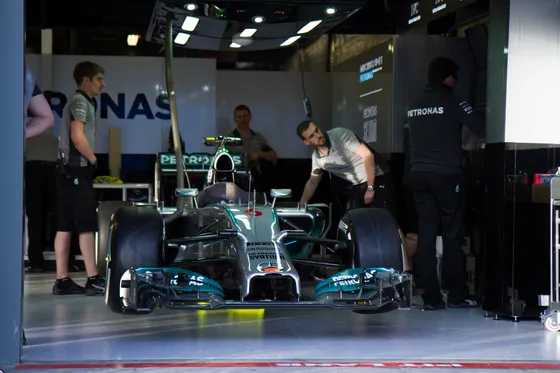 Article II · Hybrid Era THE 2014 RESET The rulebook that rewrote the grid. Read the story
 -
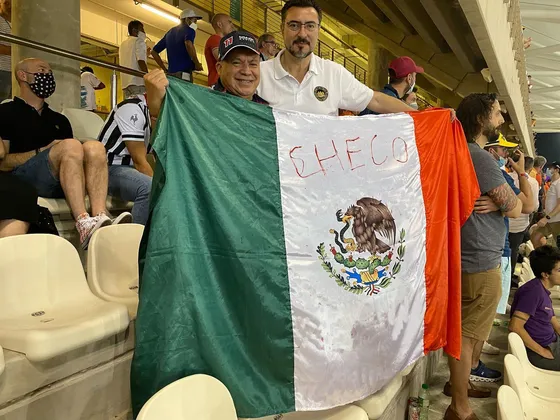 Article I · Hybrid Era ABU DHABI 2021 The race that changed Formula 1. Read the story
 -
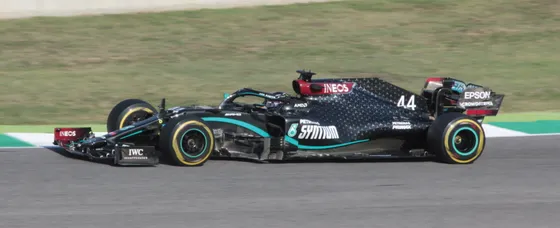 Article IV · Hybrid Era ISTANBUL 2020 Seven. Read the story
 -
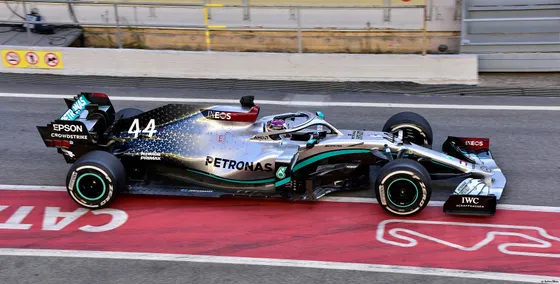 Article III · Hybrid Era THE SILVER MACHINE How Brackley built eight. Read the story
 -
 Article V · Hybrid Era 2021 The War Read the story
Eras of Formula 1
7 eras · 1950 → now
1950 – 1960
Front-Engine Era
The world championship begins in 1950 with the engine ahead of the driver and the factory teams of Italy and Mercedes setting the pace. Cooper mounts the engine behind the driver instead, and from 1959 the new layout dominates; 1960 is the last year of the 2.5-litre formula.
Read · WHERE IT ALL BEGAN · Read · THE ENGINE MOVED BACKWARD
1961 – 1965
1.5-Litre Years
For 1961 the engines shrink to 1.5 litres, and every team switches from front to mid-engined cars. The power is modest; the revolution is the layout.
1966 – 1976
Three Litres and the Cosworth DFV
Engine capacity doubles to three litres in 1966, and from 1967 the Cosworth DFV lets a small team bolt a winning engine straight to its chassis. The DFV dominates for the next decade; this era closes where the turbo era opens.
1977 – 1988
Turbo Era
Renault arrives at the 1977 British Grand Prix with a 1.5-litre turbocharged engine nobody had found the money or interest to build before, and by the start of the 1980s turbo power is the way to stay competitive. This era is dated from the first turbo car, not the first turbo-dominant seasons; turbos are banned outright from 1989.
1989 – 2005
Naturally Aspirated: the V10 Years
With turbos banned from 1989, Formula 1 returns to naturally aspirated engines, and the V10 wins the argument — Renault's V10s dominate the mid-1990s even as capacity drops to three litres in 1995. The configuration carries the sport to 2005, the last season before mandatory V8s.
2006 – 2013
V8 Era
From 2006 every engine is a 2.4-litre V8, rev-limited tighter as the sport cuts costs through the late 2000s. It is the last formula before hybrid power.
2014 – now
Hybrid V6 Era
In 2014 the V8s give way to 1.6-litre turbocharged V6 hybrids — power units, in the new vocabulary — that recover energy from braking and from exhaust heat. A new engine specification follows in 2026.
THE CIRCUIT ARCHIVE
MONACO
3.337 km · 19 corners · 1929 to now.
Walk the circuit, corner by corner
A second sport
The archive is quietly taking up another one.
Smaller court, faster hands — and it's live this week.
See which one →