Brackley, Northamptonshire. 2011. The cars that leave this building carry
silver paint over their carbon fibre.
Inside, the work is different from the result. The people who will build the dominant machine of the next decade are here. Some of them do not know it yet.
Chapter I
THE BET
The team that becomes the dominant force of the
Honda announced its withdrawal from Formula 1 in December 2008, a casualty of
the 2008 financial crisis.
Then Mercedes returns to the sport.
Daimler AG and Aabar Investments acquire a 75.1% stake in Brawn GP on
16 November 2009.
The early years are respectable and nothing more. The team goes winless for two
seasons. The first victory, Rosberg at the 2012 Chinese Grand Prix, is also the
first for a Mercedes works entry in 57
years.
The leadership that arrives in January 2013 changes everything.
Toto Wolff leaves Williams, where he had been executive director, to take an
equivalent role at Mercedes.
He brings Niki Lauda.
Lauda had been named non-executive chairman of the team in September 2012,
holding 10% of Mercedes-Benz Grand Prix
Ltd.
Hamilton arrives for 2013. The car is not yet ready to win the championship. One year later it is.
Chapter II
THE ENGINE
While Wolff restructures Brackley, a separate operation at Brixworth is building the machine that makes everything else possible.
The facility traces back to 1983, when Mario Illien and Paul Morgan founded
Ilmor Engineering, an independent British Formula 1 engine
manufacturer.
The 2014 technical regulations create a new category of machine. The
Every manufacturer builds to the same rulebook. Not every manufacturer reads it the same way.
Mercedes places the turbocharger compressor at the front of the engine, and the
turbine at the rear. Between them, mounted in the vee of the V6, sits the
MGU-H.
The 2014 rules also replace the previous era’s outright engine freeze with a
Chapter III
THE FIGHT
The W05 takes sixteen wins from nineteen races in
2014.
The fight that remains is silver against silver.
Hamilton wins eleven races; Rosberg wins five.
Then 2016 becomes the season that tests the organisation.
Mercedes wins nineteen of twenty-one
races.
Inside the team, the atmosphere is different.
Hamilton wins ten races; Rosberg wins nine. Rosberg finishes on 385 points;
Hamilton on 380.
The team is being pulled apart by its own excellence. There is only one car to win in. Both drivers can win in it. The rest of the grid cannot.
Five days after winning the championship, Rosberg
retires.
Niki Lauda would stay with the team until his death in May 2019; Mercedes won
six constructors’ championships in his time as
chairman.
The 2016 Drivers' Championship: final numbers
Nico Rosberg: 385 points, 9 wins. Lewis Hamilton: 380 points, 10
wins.
Chapter IV
EIGHT
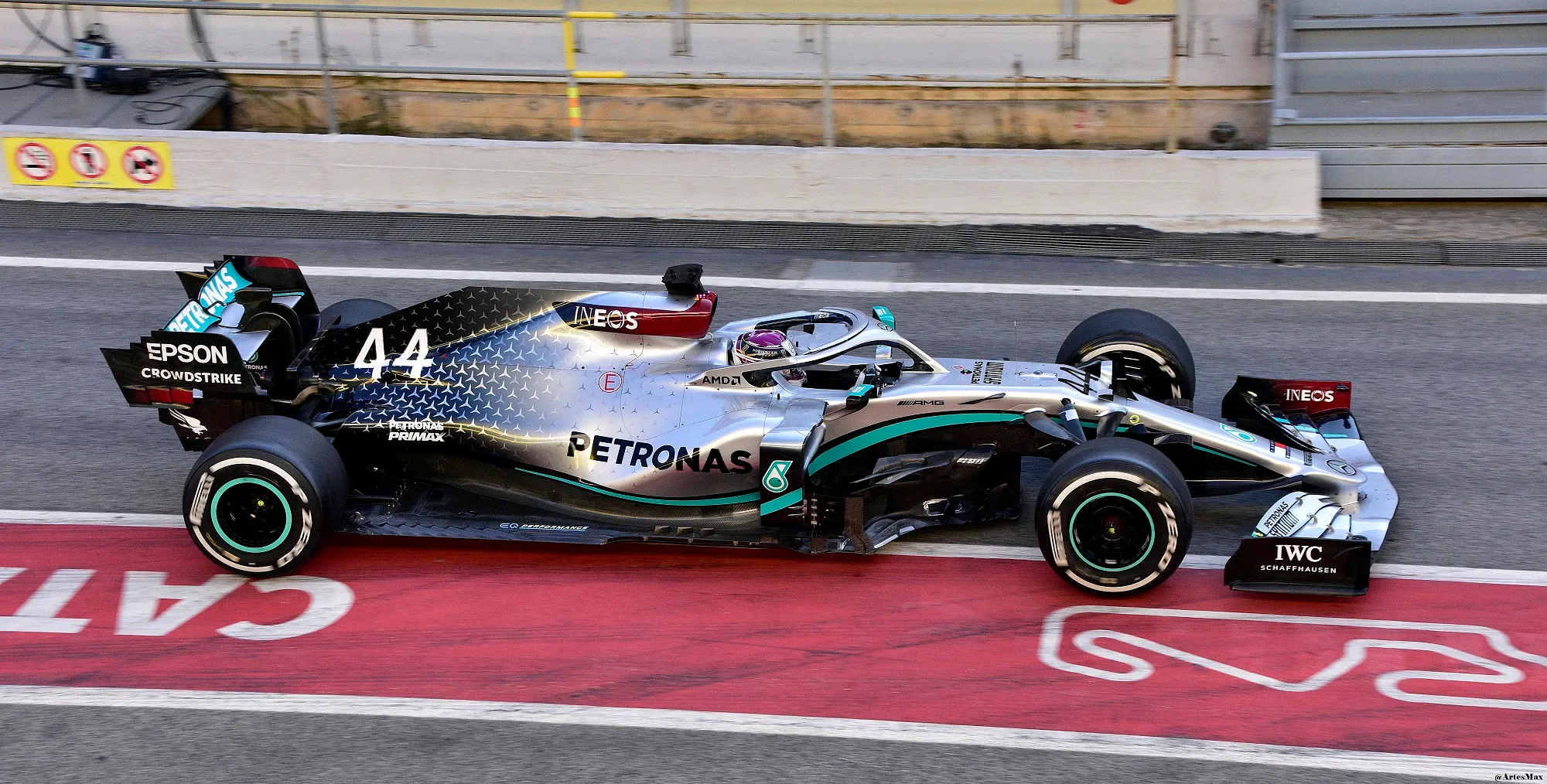
Championships arrive in sequence. 2017: Hamilton. 2018: Hamilton. 2019: Hamilton.
2020: Hamilton again.
Eight consecutive constructors’ championships, 2014 through
2021.
The final year is the hardest-won. In 2021 Red Bull, with a revived car around
Max Verstappen, wins eleven races to Mercedes’ nine.
Eight seasons is long enough for everything around a team to change. Rosberg
leaves, and Valtteri Bottas is announced as his replacement within
weeks.
The structure underneath does not change. The chassis is built at Brackley; the
power unit at Brixworth. Both belong to the same organisation — the team
designs both halves of its own
machine.
Mercedes constructor points by season during the streak: 2014 — 701; 2015 — 703;
2016 — 765; 2017 — 668; 2018 — 655; 2019 — 739;
2020 — 573; 2021 — 613.5.
Chapter V
THE FORMULA
In 2022 the rules change again, reintroducing ground-effect
aerodynamics.
The streak ends.
What the eight years establish is not primarily about any driver. Hamilton wins
six championships at Mercedes — 2014, 2015, 2017, 2018, 2019, 2020 — and
Rosberg wins one in 2016.
The question is how an organisation sustains a technical advantage across regulation cycles. How does it build engines and chassis as a single system rather than two separate efforts?
Part of the answer is in the ownership registry: Wolff holding 30% of
Mercedes-Benz Grand Prix Ltd, Lauda 10%, the parent company the
rest.
Eight consecutive constructors’ championships is a
record.
The machine runs on silver. The fuel is institutional.
Sources
- [35] Mercedes-AMG Petronas F1 Team — Wikipedia en.wikipedia.org ↗ Accessed 2026-06-10.
- [36] Brawn GP — Wikipedia en.wikipedia.org ↗ Accessed 2026-06-10.
- [37] Mercedes AMG High Performance Powertrains — Wikipedia en.wikipedia.org ↗ Accessed 2026-06-10.
- [38] Toto Wolff — Wikipedia en.wikipedia.org ↗ Accessed 2026-06-10.
- [39] Niki Lauda — Wikipedia en.wikipedia.org ↗ Accessed 2026-06-10.
- [46] Ross Brawn — Wikipedia en.wikipedia.org ↗ Accessed 2026-06-10.
- [69] Nico Rosberg — Wikipedia en.wikipedia.org ↗ Accessed 2026-06-10.
- [63] 2010 Final Constructor Standings — Jolpica F1 API api.jolpi.ca ↗ Accessed 2026-06-10.
- [64] 2012 Race Winners (P1 results) — Jolpica F1 API api.jolpi.ca ↗ Accessed 2026-06-10.
- [40] 2014 Final Constructor Standings — Jolpica F1 API api.jolpi.ca ↗ Accessed 2026-06-10.
- [65] 2015 Final Constructor Standings — Jolpica F1 API api.jolpi.ca ↗ Accessed 2026-06-10.
- [41] 2016 Final Constructor Standings — Jolpica F1 API api.jolpi.ca ↗ Accessed 2026-06-10.
- [42] 2016 Final Driver Standings — Jolpica F1 API api.jolpi.ca ↗ Accessed 2026-06-10.
- [66] 2017 Final Constructor Standings — Jolpica F1 API api.jolpi.ca ↗ Accessed 2026-06-10.
- [67] 2018 Final Constructor Standings — Jolpica F1 API api.jolpi.ca ↗ Accessed 2026-06-10.
- [68] 2019 Final Constructor Standings — Jolpica F1 API api.jolpi.ca ↗ Accessed 2026-06-10.
- [53] 2020 Final Constructor Standings — Jolpica F1 API api.jolpi.ca ↗ Accessed 2026-06-10.
- [43] 2021 Final Constructor Standings — Jolpica F1 API api.jolpi.ca ↗ Accessed 2026-06-10.
- [44] 2016 Formula One World Championship — Wikipedia en.wikipedia.org ↗ Accessed 2026-06-10.
- [45] Mercedes F1 W07 Hybrid — Wikipedia en.wikipedia.org ↗ Accessed 2026-06-10.
- [32] Mercedes W05 — Racecar Engineering www.racecar-engineering.com ↗ Accessed 2026-06-10.
- [33] Mercedes F1 W05 Hybrid — Wikipedia en.wikipedia.org ↗ Accessed 2026-06-10.
- [23] 2014 Formula One World Championship — Wikipedia en.wikipedia.org ↗ Accessed 2026-06-10.