Istanbul Park. November 15, 2020. The track surface is new. Fresh
tarmac laid in the weeks before the race: bitumen rising to the surface
in the cold, grip almost absent.
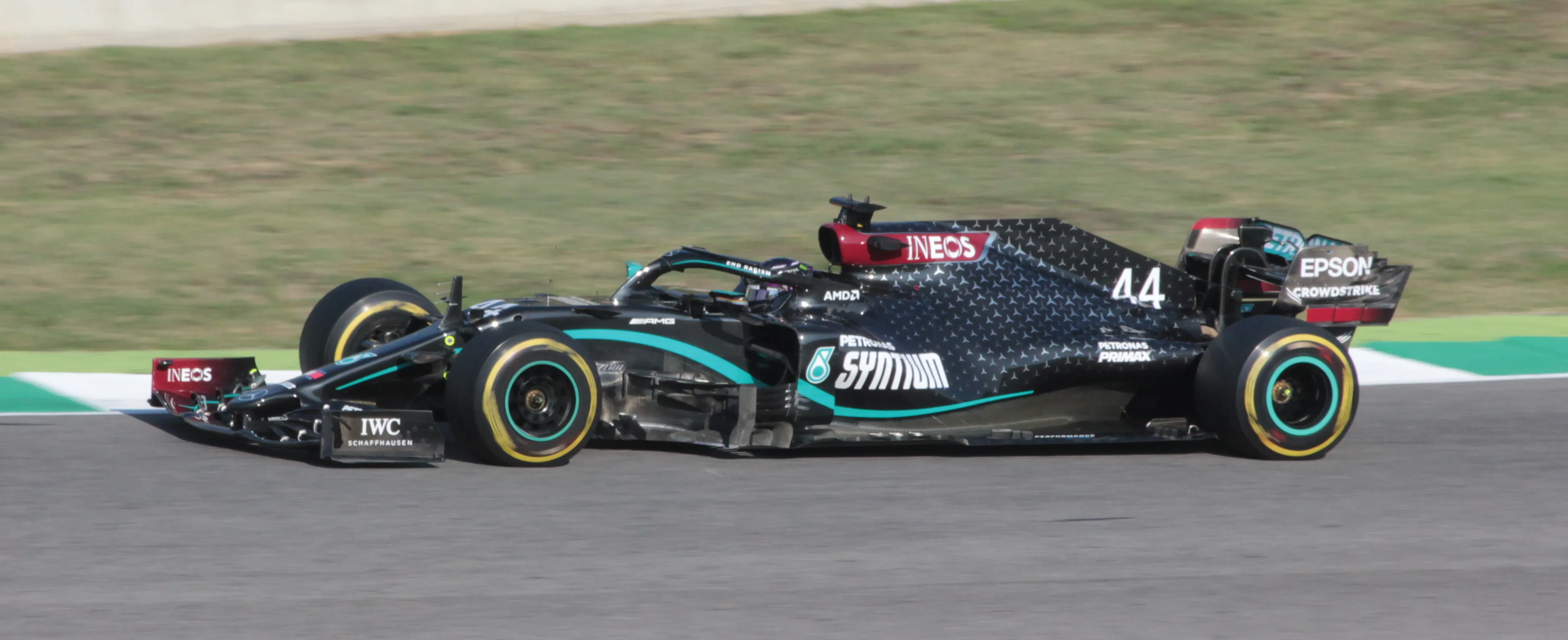
Lewis Hamilton wins by thirty-one seconds.
Chapter I
THE SEASON
The 2020 Formula One World Championship was supposed to be
twenty-two rounds.
It becomes seventeen.
A virus that began reshaping the world in early 2020 forces the season
to stop before it starts. The teams arrive in Melbourne expecting to
race. Three days before the Australian Grand Prix, the traditional
opening round, a McLaren team member tests positive and the team
withdraws; the next morning, the race is cancelled outright. The start
of the championship is pushed back to July. For nearly four months,
there is no racing.
When the season starts in July, the venues are empty. The first eight
rounds run behind closed doors, without
spectators.
Hamilton wins eleven of them.
He finishes the season with 347 points.
Before Turkey, he has already done something else. At Round 12,
Portimão, the Portuguese Grand Prix, Hamilton takes his 92nd victory,
breaking the record of 91 career wins that had belonged to Michael
Schumacher.
Chapter II
THE TRACK
Istanbul Park is a circuit the Formula 1 calendar abandoned in
2011.
The consequence is immediate. There is almost no grip.
Fresh asphalt does not behave like worn asphalt. The bitumen migrates
to the surface. In cold November temperatures it stays slick. The
traction coefficient that drivers expect from a mature race surface,
the kind that has been scrubbed in by years of tyre compounds and
rubber deposits, is simply not there.
Friday practice confirms it. Cars slide. Lap times in first practice
run roughly ten seconds slower than the circuit’s previous Grand Prix,
fifteen to twenty seconds off projected qualifying pace. Teams scramble
to recalibrate
Qualifying produces an unusual grid.
Lance Stroll, driving for the Racing Point team in a car that has
underperformed expectations for most of the season, takes
Hamilton is sixth.
His Q3 time is 1:52.560, nearly five seconds off Stroll’s
pole.
Bottas, Hamilton’s only realistic championship rival, qualifies
ninth.
The grid does not reflect the championship stakes. The car that will settle the title is on the third row.
Chapter III
THE RACE
Rain falls half an hour before the start and soaks the circuit. The
field lines up on full
Hamilton pits on lap 8.
The stop is 23.860 seconds.
The race runs to 58 laps.
It is not conventional strategy. The conventional reading would be a
second stop: trade old tyres for new ones, lose position, gain pace. The
Stroll leads all but three of the first 35 laps. On lap 36 Racing
Point brings him in for a new set of intermediates; he struggles on
the new rubber and falls to ninth by the flag.
He does not relinquish it.
Bottas’s afternoon disintegrates. Contact with Esteban Ocon on the
opening lap leaves his Mercedes with steering damage; he spins six
times during the race and finishes fourteenth, a lap
down.
Race top-5 finishers: 2020 Turkish Grand Prix
- Lewis Hamilton (Mercedes): 1:42:19.313 (58 laps).
- Sergio Pérez (Racing Point).
- Sebastian Vettel (Ferrari).
- Charles Leclerc (Ferrari).
- Carlos Sainz (McLaren).
Fastest lap: Lando Norris (McLaren) 1:36.806 on lap 58.
Valtteri Bottas (Mercedes): P14, championship rival eliminated mathematically.
Chapter IV
THE MOMENT
The chequered flag falls on lap 58.
Hamilton crosses the line. He has won the race. He has finished ahead
of Bottas, the one condition that mattered. The championship is
settled.
Seventh. He has won his seventh World Drivers’ Championship,
equalling the record Michael Schumacher
set.
There are no spectators. The race is run behind closed doors; the
grandstands at Istanbul Park are
empty.
None of those conditions were ideal. All of them happened.
Chapter V
THE NUMBER
The record Hamilton equalled belongs to Michael Schumacher.
Schumacher won his first championship in
1994.
Five championships with Ferrari: 2000, 2001, 2002, 2003,
2004.
Seven championships total.
Hamilton’s seven arrive differently. The 2008 title with
McLaren,
The comparison between them (Schumacher’s seven and Hamilton’s seven ) is a question for historians and anyone who watched both. The context differs, the competition differs, and the technical landscape differs. The people who argue it will not agree, and they will not agree for good reasons.
What is recorded is this: two drivers. Seven titles each. The same number, reached by different routes, across different decades.
2020 championship final standings (top 5):
P1 Hamilton (Mercedes): 347 points, 11
wins.
P2 Bottas (Mercedes): 223 points, 2
wins.
P3 Verstappen (Red Bull): 214 points, 2
wins.
P4 Pérez (Racing Point): 125 points, 1
win.
P5 Ricciardo (Renault): 119 points, 0
wins.
Constructors:
P1 Mercedes: 573 points, 13
wins.
P2 Red Bull: 319 points, 2
wins.
Istanbul Park. November 2020. The stands are empty. The tarmac is
new. The tyres are worn down to nothing. The championship is
decided.
Seven.
Sources
- [47] 2020 Turkish Grand Prix , Wikipedia en.wikipedia.org ↗ Accessed 2026-06-10.
- [48] 2020 Formula One World Championship , Wikipedia en.wikipedia.org ↗ Accessed 2026-06-10.
- [49] 2020 Turkish Grand Prix: Race Results , Jolpica F1 API api.jolpi.ca ↗ Accessed 2026-06-10.
- [50] 2020 Turkish Grand Prix: Qualifying Results , Jolpica F1 API api.jolpi.ca ↗ Accessed 2026-06-10.
- [51] 2020 Turkish Grand Prix: Pit Stop Data , Jolpica F1 API api.jolpi.ca ↗ Accessed 2026-06-10.
- [52] 2020 Final Driver Standings , Jolpica F1 API api.jolpi.ca ↗ Accessed 2026-06-10.
- [53] 2020 Final Constructor Standings , Jolpica F1 API api.jolpi.ca ↗ Accessed 2026-06-10.
- [54] Michael Schumacher , Wikipedia en.wikipedia.org ↗ Accessed 2026-06-10.
- [35] Mercedes-AMG Petronas F1 Team , Wikipedia en.wikipedia.org ↗ Accessed 2026-06-10.
- [70] Lewis Hamilton , Wikipedia en.wikipedia.org ↗ Accessed 2026-06-10.
- [34] Formula One engines , Wikipedia en.wikipedia.org ↗ Accessed 2026-06-10.